‘They hid it away’: The DNA test that revealed an Australian cricketer’s family secret
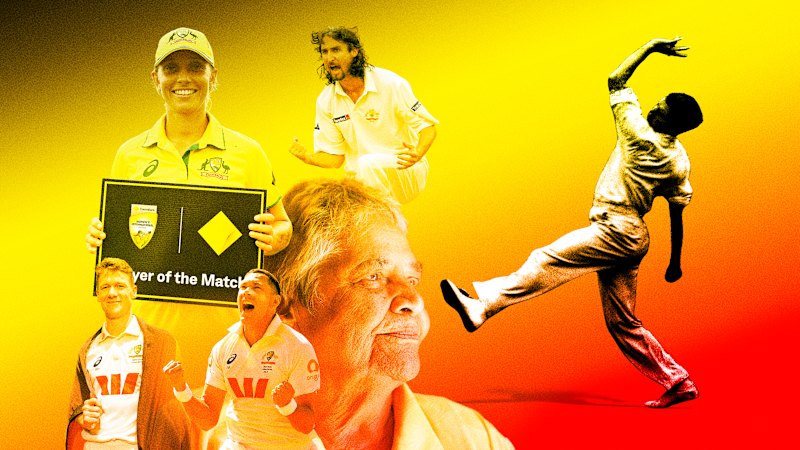
Hughes remembers Gaunt’s skill as a technical coach, plus his ability to still send down beautiful outswing in the nets. But what sticks with him is the older man’s personal touch – sports psychology before it had the name.“You could talk to him about anything,” Hughes says. “He could pick up on if you were having a bad day or whatever, and that’s the philosophy I take with kids now. You talk to them, and it’s not just about cricket, but about school, are exams coming up? If guys aren’t concentrating on their bowling, you try to get to the bottom of it, and he used to do that beautifully.”He knew you had the talent and if you weren’t producing at training he’d try to get to the bottom of it. He’d say, ‘Listen, you’re at training, you can leave that behind, and concentrate on your training’.”Some earthier incentives came when Hughes and Footscray were fighting for their lives in the 1980 first-grade grand final.“In the first XI grand final I played in my second year at Footscray, there was 10 and 11 batting, and he just said, ‘Right boys, if you can get to double figures here I’ll buy you a slab’,” Hughes remembers. “How hard do you reckon we worked to get those runs?“If you did well, he was always there for you. It wasn’t him beating his chest, it was just him patting you on the back and saying, ’Well done’.”Dodemaide, a couple of years younger than Hughes, can recall watching Gaunt bowl, perhaps planting a seed that led an initially front-on bowler to change his action to allow for the away swingers that netted Dodemaide 10 Test caps.“He had the tracksuit on and was clearly well past playing age, but he went in to bowl a few balls and demonstrate what he was talking about, and he had this beautiful side-on jump and action, and it was just so smooth,” says Dodemaide, now an Australian selector. “I thought, ‘Wow, could I ever bowl like this bloke?’“Having a couple of Test players around the club was just gold for a young kid like me. He only played a handful of Tests, but that was enough as far as we were concerned – to spend any time around someone who’d played at that level of cricket.”None of Hughes, Dodemaide or even his fellow Footscray Test cricketer Ken Eastwoood had any idea about Gaunt’s heritage.“I never knew that, but that’s a real feather in his cap,” Hughes says. “Times have changed for the better. I thought I spent a fair bit of time with him, but it was never mentioned. Back then he might’ve been hiding that heritage.”There is one former teammate, Lindsay James, who has told Dodemaide that Gaunt did indeed know of his Indigenous heritage, and that the pair discussed it quietly, once, long after both had finished playing and coaching.“I couldn’t imagine him being a fearsome fast bowler,” Dodemaide says. “He had such a gentle demeanour about him, and very generous with his time and experience.”After retirement, Gaunt moved to the NSW Central Coast to share more time with his children, Karon and Andrew. Gaunt and their mother had divorced when Andrew was two years old.“Once a year we used to get to see my father around Christmas time for a month, [and] then he’d have to go back to Victoria to work,” Andrew says. “But when I was around 21-22, I went and stayed with him for a few years, and that was good. He was pretty much just like a mate, he spoke like a mate and that’s how we were.“I came back to Sydney after a couple of years, and we kept in closer contact, and, eventually, he retired up the Central Coast and I went up and stayed there for a while. But work was back here in Sydney. So I was always going up there weekly, pretty much for years.”Sport in general, and cricket in particular, was never far away from the conversation.“You had no choice on the TV, it was cricket when it started until it finished, then he’d go, ‘OK it’s yours now’,” Andrew recalls. “He never boasted, he never bragged, that wasn’t him. Other people who knew him would say, ‘That’s Ronnie Gaunt, he used to play for Australia’. But he’d never say that. He wouldn’t talk too much about it – what happens on tour stays on tour almost.”If Gaunt was taciturn about his cricket achievements, his heritage was buried deeper still, remaining unknown to the family when Ron died in 2012. Eight years later, during COVID-19, Andrew’s half-sister Kellie started digging into family history. Ancestry searches were followed by DNA tests, revealing a hidden Indigenous bloodline.“One day, out of the blue she gave me a call and said, ‘Andrew, guess what, you’ll never believe it’, and I just said, ‘Nah, get out of here’. And my other sister Karon couldn’t believe it at all.“Then Kellie got in contact with Jenny, and she took it up and ran with it. It was a such a well-kept secret, and maybe that was a reason why. He may not have played for Australia or got the chances he did if they knew he had Indigenous background.“I was speaking to my sisters about Jason Gillespie saying, ‘Geez, he’s supposed to be the first person of Indigenous blood to play for Australia’. I started laughing about that and going, ‘Oh man, sorry about that’.”Ask Andrew what he might have said to his father had he known, and he pauses.“I’d probably have said, ‘What the hell were you thinking?’” he laughs. “I’m actually quite proud or glad, it just cements that footprint in our family as a full-on Aussie. But I don’t think they looked at it like that.”While Ron got his mother Ruby’s red hair, Andrew and Jenny are both darker in complexion. Andrew can remember, as a teenager, that Ron got them together at Martin Place in Sydney.“I met Jenny one time when I was about 16,” he says. “Dad was in Melbourne at the time, but he came up to see us. He wanted me to go and meet my cousin, he goes, ‘Come and meet your cousin’, and Karon said, ‘What about me?’ and he says, ‘Nah, just Andrew’. I thought that was a bit odd.“That’s the first and last time I met Jenny [who moved to the United States, where she still lives]. But I think Dad was sizing me up with her because we were both darker in complexion. That’s just my take, but my sisters Karon and Kellie thought that made sense.”After Jenny took up the family research, she passed much of the information onto Dudley Gaunt, who still lives in WA. He has had inconclusive discussions with WA Cricket about Ron’s Indigenous heritage, and has also made attempts to contact the Ballardong Noongar community. Cricket Australia is looking into the Gaunt family story.“We want to ensure cricket’s heritage fully reflects all those from different backgrounds who have contributed to the game,” a CA spokesman said.“The stories provided by those exploring family ancestry is an important way to ensure the diverse backgrounds of past players is recognised.”Dudley says the main issue in his meeting with WA Cricket was not Gaunt’s Aboriginality, “It was whether he accepted his Aboriginality, whether he told people. Did he tell people at South Perth cricket club?“If he wouldn’t have been able to play cricket, why would he tell anyone at South Perth that he was Aboriginal? It was a different time, they parked it away, hid it and got on with their lives.”In 2005, the former chief justice of NSW, James Spiegelman, spoke about hidden Aboriginal histories in that year’s Charles Perkins Oration.“Let me state one undeniable fact: many, probably millions of Australians have an Aboriginal ancestor,” he said. “This should be recognised as an important bond. However, most do not know this fact about their family.“There was a strong sense of racism involved in the suppression in thousands upon thousands of Australian families of the Aboriginal origins of one or more of their forebears. For most of our history this has been regarded as a matter to be suppressed.“It appears to me that the process of reconciliation would be advanced by a wider recognition across the broad Australian community that the number of Australians who have Aboriginal ancestors probably amounts to millions.“The reconciliation process cannot succeed if it is based, contrary to historical fact, solely on maintaining a rigid and categorical distinction between black and white. It will succeed if a significant proportion of those Australians of whom it is true take pride in acknowledging their roots in both communities.”For Jenny, the secret is itself a significant part of the story.“I was very proud to find that out myself, to think we’ve got heritage that goes back 60,000 years in Australia,” she says. “But in going back to speak to the family, I found out that the family did know, and didn’t say anything.“I was shocked, thinking, ‘Gosh they kept it a good secret all those years’. But a lot of it might have been that they wanted to work and get on with their lives. This is my opinion – because Ron was playing cricket and very successful, they wanted that to keep going and that it wasn’t made more difficult for him.”Andrew recalls one other comment from his father that has taken on new meaning.“My dad used to tell me, ‘You have a whole other family in the west’,” he says. “It was a big secret, and back then I could understand it. Whereas now I’m like, ‘Wow, that’s cool’.”


Most Popular