"The directive from Edward Rogers to me is to do whatever it takes to win a Stanley Cup"
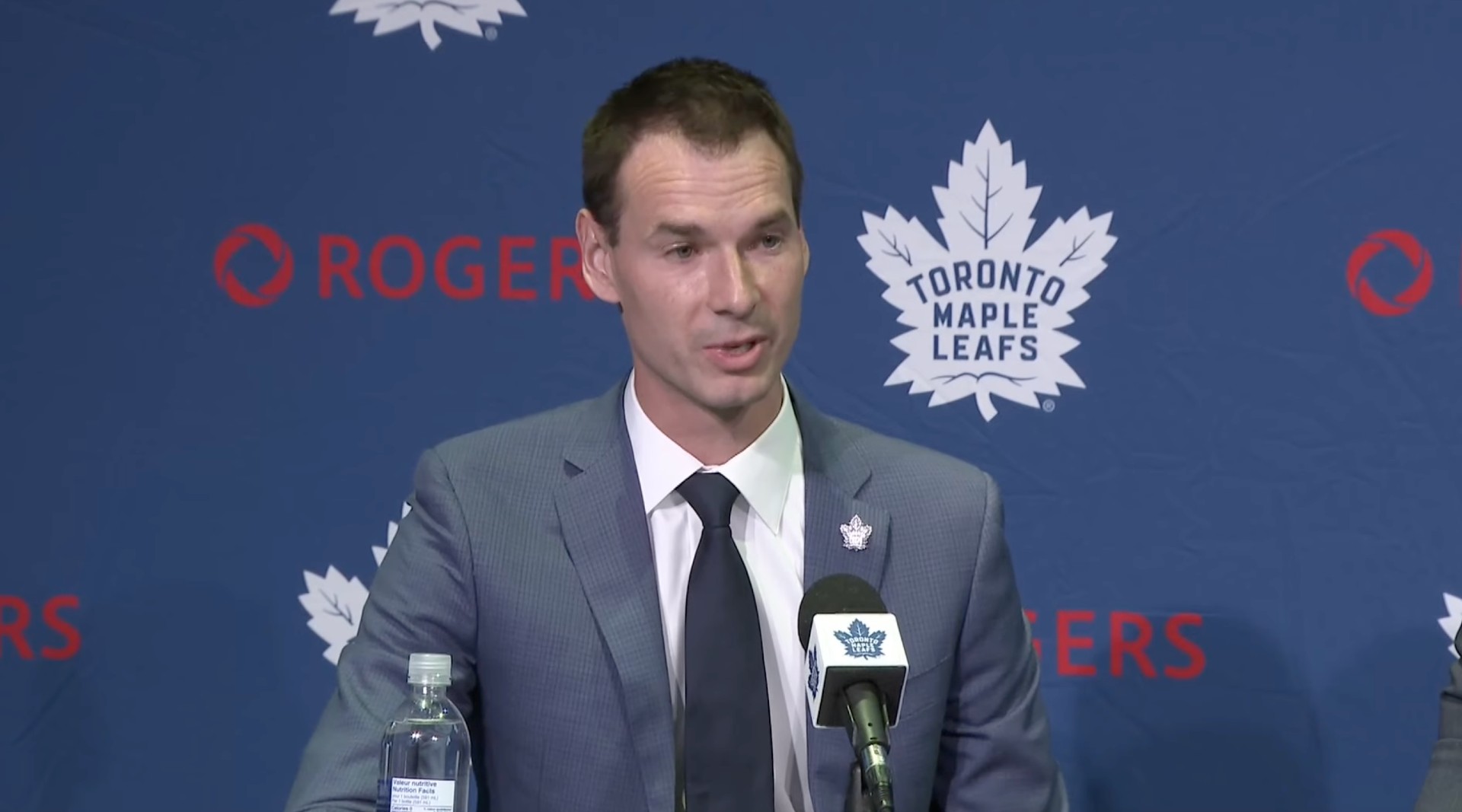
Maple Leafs GM John Chayka joined TSN Overdrive to discuss the draft lottery win, the process of deciding on a first-overall selection, the report of uncertainty on Auston Matthews’ behalf about returning in the Fall, and whether he believes the team can contend next season.Take us through your viewing experience of the draft lottery.Chayka: I was standing beside Mats, and he kept telling me how he was not going to win, and it was not going to happen. I keep trying to keep him optimistic. He is a lucky Swede, so we got it done.You had a plan going into the lottery, and then you won it. Does that potentially change your plan, or does it give you more options?Chayka: The nice part is that we just started. We have a plan to build out the organization. We didn’t have a plan in the draft yet. We knew there was optionality to what would happen. There was a wide range, from winning—which we ultimately did—to losing the pick, even. We were kind of thinking about and planning for all of those circumstances.Obviously, the best possible outcome happened. Lucky is a funny thing. You need it to have success long-term. That’s a big one.Does this speed up the process of getting familiar with scouts and everybody’s books on these prospects?Chayka: We had a few meetings already scheduled for today, so it ended up lining up well. Honestly, these guys, with these players now, have seen them for multiple years. It is always about getting a good book on the players. I have a lot of confidence in the group we have here. It is a veteran group. I spent some time with them today and feel really comfortable with where they have things.Again, it is a big decision. We have to be thorough and diligent, but I have no reservations that this group isn’t prepared to make the right decision.When it comes to the GM’s role in draft picks, it’s doubtful you are watching hundreds of prospects. Once in the fifth and sixth rounds, you surely rely on your scouts to tell you who you should go for or who fits what you’re looking for. How does it apply to the first overall pick and your specific role in knowing the four or five guys on the shortlist? Are you going to work more on this pick because you can narrow it down to a few guys?Chayka: It is a great question.I would just say every manager is different in how they approach the draft. Certainly, for some guys, that is how they were brought up, and that is what they love to do. They are super involved and engaged. That is great.From my seat, I am always a big process guy. It is a really hard thing to do. It is one of the most challenging problems I’ve ever come across in life. I just find that their experience, their intuition, what they’ve gone through, and what they’ve learned — the mistakes they’ve made, the adjustments they’ve made over decades — are super important.Obviously, the first overall pick is an organizational pick. It is an important one to get right. We’ll dig in, and I’ll be a part of that process. I’d say that my part, honestly, is a part of it. At the end of the day, it will be on my record, and I own that. At the same time, that’s why you need a good staff and empower them to do a good job.You are data-driven. How has the way scouting has been processed changed over the years, such as watching on video as opposed to being in the building to watch prospects?Chayka: As any business evolves, new technologies come out, and you evolve your process.One of the challenges, in hockey specifically, is that there is this massive player pool across different continents. If you are one person trying to get a good feel for the entire draft, it is almost impossible to get a good sample size. You can see everybody, but I think it is a bit of a supplement. How can you use data, video, and in-person experiences to get the fullest picture possible?Even after you’ve done all of that, it is a very challenging decision to make. You are trying to blend all of these things in a really artistic way, rather than as pure science. Anyone who has gone through it and done it has the humility to understand that viewings are helpful, and certainly, being live, feeling it, and seeing stuff away from the puck brings a lot to the table. If you are also trying to make sure you aren’t missing anything and are seeing players in different segments of the season or against different competition, supplementing some of those viewings can be really valuable.For people listening, what does it mean when you are described as a “data” or “analytics” guy? As far as your view of a hockey team and your associations, how does it all come together?Chayka: It is just really hard to win in the NHL. There are a ton of really smart people doing great work. They have a lot of experience and knowledge. You are always trying to find an advantage, an edge, something different. You are not trying to play the exact same game as everybody else and hoping the ping-pong balls hit every year for you. What can you do that is different and gives you a right to win?With my background and experience, I feel like I have a lot of experience on the data side. Having said that, no matter what your experience is, you have to be cognizant of not over-indexing to something or under-indexing the other way.I really believe in the power of the room, as I’ve said before. These are really hard decisions. If you get the best people around the table, and put all of the information on the table in terms of the qualitative and quantitative evaluations, your book on the players, and anything you’ve got on them in terms of intangibles… It is hard when you’re trying to weigh all of these things in different ways, and it is always different depending on the players, the situation, the part of the draft you’re in. It’ll evolve, and it is never the same weighing.Ultimately, you have to be right when you make your pick. You want to have a lot of conviction that you’ve turned over every stone and looked at it from every different angle. And then you have to make a judgment call.Intangibles—physicality, intimidation—all play a role in the sport. Fairly or unfairly, you’ve been labeled just the data guy. Do you want to address that, and how important it is to make sure there is a physical element to the Leafs‘ game when building for the future?Chayka: Much like any fan, when you turn on playoff hockey, it doesn’t take you long to figure it out. It is a battle out there. You’ve got to be ready physically and mentally to go out and compete at that level.That is a reason why Mats Sundin is a big part of what we’re doing. He is a guy who has been in those situations and knows what it takes. He will be a big part of our decision-making process. We’re going to surround ourselves with a lot of individuals like Mats who have similar or different backgrounds who can bring those elements to the table and an understanding of what it means.If you are going to win, you have to be good across the board. Certainly, at this time of year, you need those elements you raised, but the pace of these games is also noticeable — not just the pace of skating but the pace of decision-making, reads, making plays under pressure, escaping pressure, and making a play.Our job is not to miss those elements in the question. Those are clearly a part of the recipe. But also have a well-rounded team so that no matter the opponent, you have a diversified attack that can match up well against anybody.There has been a lot of speculation about your specific relationships with other GMs in the league. Why do you think your relationships are like with other GMs around the league?Chayka: It is a fair question.From my side, I’d say the folks I know — which is a large majority — I think I have pretty good relationships with.I would just point to my history of making transactions. We made quite a few in Arizona as we were trying to kind of move that team around and get into a competitive position.The main theme is that, whenever you are trying to make a deal or create a transaction, there are two sides to the equation, and you are trying to understand what they’re trying to accomplish while trying to accomplish something for your club as well.By no means am I looking to make friends or anything like that. I am trying to do the best thing in the interest of the Toronto Maple Leafs. Those are my loyalties. That is where that lies. For Ed Rogers, Keith Pelley, and the whole staff, that is my focus.At the same time, to get transactions done consistently, you do need to be honest, forthright, and direct in your dealings. Historically, I’ve been able to do that.Keith Pelley was not concerned about your history or time in Arizona, or the way you left Arizona. He said you impressed him with your vision. Can you shed light on this? We are not asking for your full blueprint for the next 10 years for the Maple Leafs, but what, in particular, tipped the scales in how Pelley chose you as the GM?Chayka: It is a good question for Keith, but from my perspective, resources aren’t a problem in Toronto. The directive from Edward Rogers to me is to do whatever it takes to win a Stanley Cup. I take that seriously.As we think about how we can gain competitive advantages, it is not just resources but being resourceful. Coming from a place like Arizona teaches you a lot. How can you be really disciplined in your decision-making? How can you be disciplined in how you spend money in a cap system? Even if you can spend to the cap, it still matters how you spend those dollars. Combining resourcefulness with the resources could be a blueprint for how we continue to evolve the organization.I do want to say that I think a lot of good things have been done over the last decade, too. We are certainly not looking to throw the baby out with the bathwater in any shape or form. A lot of good people have done a lot of good work over a long period of time.Mats and I are coming in with a different slant and maybe a fresh perspective. We’re going to iterate on things. Ultimately, Keith was looking for someone to come in, build bridges between departments, and take what is here to another level.You mentioned you were younger and a lot different back in Arizona. This is a different beast in Toronto. How different are you, and how different will your approach be?Chayka: I was 26. I was dating. I am now 36 and married. I’ve had three kids. Life changes.I am always looking to improve and do different things. I’ve done some things on the business side in different formats. I’ll look to bring some best practices from there as well.I’ve spent a lot of time in global sports — global football, baseball, and the NBA, even. The common theme is just the human element. There is just a human connectivity, a pulse, and a heartbeat to these environments. Again, you can have the most talented teams in the world, but I don’t think that will get the job done. While talent is an essential part of the equation, I don’t think it is a sufficient part.Anything we can do with the Leafs to continue building culture—that is why I love having Mats Sundin as a partner in this, someone who knows the market, has lived it, has felt its weight, but has also embraced what it is and what it means. I don’t have that perspective, of course, so having the best front office matters.As far as the culture already in place, how are you going to drill down on the culture here? Are you going to ask around and get to know the guys? Have you spoken to Auston Matthews and William Nylander about what’s up here? How will you find out?Chayka: At the end of the day, I think it is about having conversations. In the last two days, we’ve been in the boardroom trying to meet with everyone, from the chef to the equipment staff to the coaches. We’re going to go through, talk to them, and get their perspective.We’re on the outside. We don’t know what we don’t know. We’re having those conversations, digging deep, and trying to have really honest conversations about where we are at. There has been a great perspective already from people who are in the room every day and have a pulse of what is going on.The question is not what has gone on in the past. The question is where to go from here; how do we get better, and how do we elevate things?Obviously, it was a disappointing season for everyone, but at the same time, I think there is a lot of resolve in a group that hasn’t missed the playoffs in a long time. Our hope is that this group can benefit from that, actually, by using some of this adversity in a positive way and bouncing back.There was a report in The Athletic that Auston Matthews is uncertain if he will even return next year. Is that your understanding of where Matthews is at right now? How do you approach that report?Chayka: That is not my understanding.Auston has invested his entire NHL career into the Toronto Maple Leafs. That has been an affirmative decision on his behalf. As he evaluates his career and what the next decade of it looks like, I think it is important that he feels a connectivity, an alignment, and has a similar vision and passion that we do.We’ll have those conversations, get together, and share notes. Honestly, I want to be a good listener. He is the captain. It is his room. He has been through the ups and downs in this market.Mats has a unique perspective to share as well. I am sure there will be some good back-and-forth in that regard.But I totally understand the perspective that you only have so many years as a player. It goes by quickly. You want to make sure you feel fully aligned and engaged in what is going on. I have no problem having those conversations, sharing those thoughts, learning, seeing whether there is a shared vision, and charting the path forward.Keith Pelly, in a roundabout way, said a few times that with the cornerstone pieces in place, with some additions and possibly getting healthy, this team could turn it around and get back into contention of some sort for the Cup next year. Do you share in that belief? Was it a big part of the interview process, what your thoughts were on this team and how quickly it can be turned around, if it’s even possible? Some think it’s not.Chayka: To share my perspective, we spent some time on this roster this season, walking through the players. That took a very small portion of the interview process. The much larger part of the process was organizational building, a vision for what a world-class organization looks like, how we can be the best in class across all of these different departments, and integrate them in a really effective way to create an advantage in the long term for the Toronto Maple Leafs.As we are doing that right now — evaluating that and trying to find the best ways to put this thing on a solid foundation, not just for my tenure but hopefully into the future — we also believe very strongly that we owe it to the players, the fans, and ownership to put the best team on the ice next year. You have to do that in a way that is thoughtful and constructive.This isn’t something where we are building a team for one season. At the same time, I do think we need to continue to push this team ahead, generate some momentum, and get some positivity back.Next year, do you think this team could turn it around, be competitive, and compete for a Stanley Cup with some additions?Chayka: As I sit here in May, the season played out, and you know the result as well as I do. The answer, as I sit here today, is that they are not the contending club we’d like them to be.We have a full offseason. We’re going to go hard. We are going to give it everything we’ve got. I am very committed to that.I think we have some world-class players. Those players deserve our best efforts to put the best team on the ice under the constraints and realities of trying to do that while 31 teams try to do the same. But it won’t be for a lack of effort on our side.As we get into training camp, I’ll be happy to answer that question with more specificity. I can say anything in May. It is more about what it looks like as we enter the season.


Most Popular
March to the 'G is Back in Round 9
4 hours ago