NFL draft 2026 takeaways: Rams reach, Cowboys retool and Jets add juice
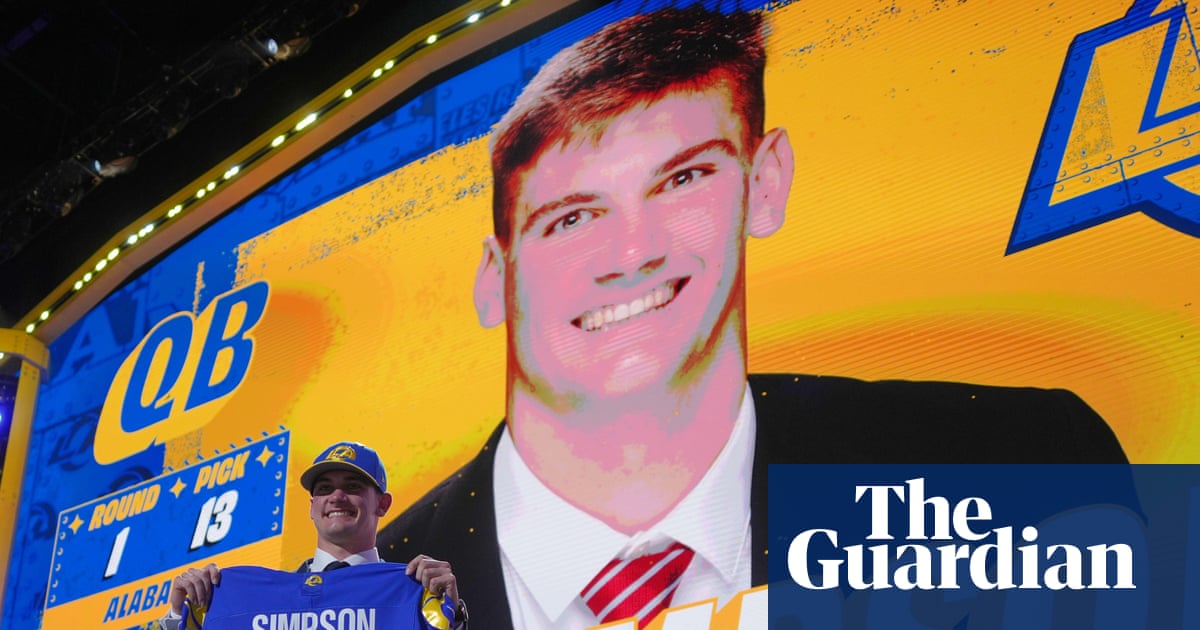
The Rams reach for Stafford’s successorThe Rams delivered the biggest shock of the night, sticking at pick No 13 and selecting Alabama quarterback Ty Simpson. It was a stunner that seemed to take even their head coach by surprise. Sean McVay seemed less than enthusiastic at the Rams’ post-pick press conference, and Simpson said in an interview that he’s never met McVay.Maybe it shouldn’t have been a shock. Simpson, who started just 15 games in college, hemmed and hawed about whether to enter the draft at all. But a key reason he entered the class was Rams general manager Les Snead telling him he was a first-round pick. On Thursday, Snead stuck to his word, reaching for a quarterback tabbed as a fringe first-round prospect.It makes some sense. The Rams don’t expect to pick in the top half of the first round again any time soon. They’re slap-bang in the middle of the championship window, with the best roster in the league. If they believe Simpson can be a viable starter, it will extend that window beyond the career of Matthew Stafford, who has toyed with retirement and has only one or two years left in the league.But taking a flier on Simpson at No 13 was a reach. He is a historic outlier in size, weight and starting experience. The history of quarterbacks arriving with so little tape is gnarly. Only one quarterback has made a Pro Bowl with 15 or fewer college starts: Mitchell Trubisky, whom the Bears couldn’t wait to move on from after four seasons. And the history of quarterbacks who play at 6ft1in, 211lb or under is just as grim. The only quarterbacks who’ve had success at that size have been either electric athletes or Drew Brees, one of the most accurate passers in the history of the league. Simpson is neither.Simpson is talented. In college, he was asked to do professional quarterback things, playing in a pro-style system and running the show from the line of scrimmage. You can see why the Rams would fall in love with his intellect, toughness and his willingness to push the ball down the field. All those skills map well to McVay’s offense; Simpson rips it over the middle of the field, and McVay’s offense is designed to generate those throws.The rest, however, is pure projection. Simpson lacks any elite tool. Inexperienced college starters are usually selected highly because they have an athletic super-skill. Simpson doesn’t. On the continuum of quarterbacks, he is closer to Mac Jones or Brock Purdy than he is to Stafford.Simpson isn’t just short, he’s light. He lacked the body armour to survive a 12-game college season. How will it hold up over a 17-to-23-game schedule against NFL size and speed? We don’t need to theorize. Last year, he took too many blows, and a rib injury wrecked his second half of the year. After looking like one of the best quarterbacks in college football over the first eight weeks of the season, he fell apart as the hits and injuries mounted up.Pairing up with McVay and learning from Stafford is the ideal landing spot for Simpson. It beats landing with the Jets or Cardinals, the other teams with serious interest. With some time behind the scenes, perhaps he can bulk up. But he needs reps against live competition, and with Stafford still at the peak of his powers, that isn’t coming any time soon.The Cowboys crush itThe Cowboys entered day one with two first-round picks and a clear mandate: to fix their defense. Last year’s unit was a disaster. Thursday night was a great step in correcting that.Dallas traded up one spot to select Ohio State safety Caleb Downs. It’s a home run pick. Downs was the best all-around player in the draft, a do-everything safety who can cover from the slot or deep down the field, bang away against the run in the box and is a weapon as a blitzer. He was the best read-and-react defender in college football, leading a Buckeyes defense that had Arvell Reese and Sonny Styles, two top-seven picks in the draft, in tackles and splash plays. Downs will also add some much-needed playmaking and versatility to Dallas’ re-made unit.In the era of Kyle Hamilton, Brian Branch, Jalen Pitre and Nick Emmanwori, safety/slot value should have gone out the window. But Downs’ slide proves the league continues to overlook the value of hybrid players in the secondary. Hamilton, Pitre, Branch and Emmanwori all slipped in the draft. Each of them is now a linchpin piece for the league’s best defenses, putting stuff on the menu that other defenses cannot access. As a prospect, Downs stacks up with all of them. He lacks Hamilton’s size, but he is a more blurry athlete who can create carnage all over the field.And the Cowboys weren’t done there. With their second pick in the first round, they traded back and still picked up one of the top edge-rushing prospects in the class, UCF’s Malachi Lawrence. Lawrence brings juice off the ball. He’s a speed-bend pass-rusher who moves a little like former Cowboys great DeMarcus Ware. Lawrence isn’t as refined as Rueben Bain or Akheem Mesidor, two of the three edge-defenders selected ahead of him, but he has a shot to be the most impactful pass-rusher from this year’s class.It’s a league of big menTies, the old cliche says, go to the big man. And the league stayed true to the rule, loading up on offensive linemen on the opening night. Nine offensive linemen came off the board in the first round, more than a quarter of the evening’s haul. Part of that is the usual league-wide panic about the trenches; part of it is a genuinely strong crop this year; and part of it, let’s be honest, is that the top of this draft was thin on the sort of blue-chip skill-position prospects that normally hoover up the early picks.Spencer Fano (Browns), Francis Mauigoa (Giants) and Kadyn Proctor (Dolphins) went at 9, 10 and 12. Vega Ioane got the interior prospects going, landing in Baltimore at pick No 14. And then the Texans decided to move up for Keylan Rutledge at 26, a mauling, slightly unhinged guard with shades of Richie Incognito. Four more tackles went between 17 and 28, with the Patriots jumping up to make sure Utah tackle Caleb Lomu didn’t get away.Proctor was the buzziest selection. Miami has been at pains to say they’re rebuilding through the trenches, trying to shed their label as a soft (yet fast) team and looking to build a more imposing, powerful group on offense. Proctor checks the box. He’s a 6ft 6in, 352lb tackle who played closer to 400lb in college. His weight and work ethic have been concerns at times, and if he continues to play heavy, he will be forced to move inside to guard. But when Proctor’s weight is under control, he’s an extraordinary athlete for his size. It’s not that complicated: guys so big shouldn’t be able to move so fluidly. Given his sheer mass, no one can run through him. Proctor has all the physical to work with and is one of the youngest players in the class despite having plenty of experience. For a Dolphins team going through a full rebuild, taking a swing on a player with All-Pro potential, most likely at guard, was a bet worth making.The electric JetsThe Jets wound up making three picks in the first round. They traded back up to pick No 30 to go along with selections at No 2 overall and No 16. All their picks had one thing in common: gas.The Jets kicked off the night by selecting Texas Tech edge-rusher David Bailey, opting for proven pass-rush juice over the hybrid Ohio State defender Arvell Reese. Reese is the better prospect, but Bailey has unteachable first-step speed and a settled position. Given his deficiencies against the run, Bailey may struggle to become a full-time starter. But pass-rush sizzle is one of the most valuable commodities in the league, and few get off the ball as quickly or play as suddenly as Bailey. He may not be as stable down-to-down, but he will create splash plays.After Bailey, the Jets turned their attention to the offense, grabbing Oregon tight end Kenyon Sadiq and Indiana wide receiver Omar Cooper Jr. Sadiq is a ridiculous athlete, with the best acceleration of the snap of any player in the class, regardless of position. His fit with new offensive coordinator Frank Reich is funky, but Sadiq has the kind of playmaking chops that Reich can build portions of his offense around. Sadiq is still somewhat of a project, both as a receiver and a blocker, but all tight ends take time to develop. And Sadiq isn’t just a combine darling. Sure, he tested like a freak, but that athleticism translates to the field. And he’s willing to play a rugged style, offering all-out effort as a blocker. Sadiq is a little boom-bust, but squint hard enough, and you can see Vernon Davis. With the Jets lacking speed all over the field, taking a gamble on one of the most explosive offensive weapons in the draft makes sense.It’s hard not to feel better about the Sadiq pick after the Jets closed out the night with Cooper, either. The Indiana receiver is a tough, shifty, slot-based player, with a hint of Puka Nacua about his game. He’s a willing blocker and creates chunk plays with the ball in his hands. There were more tantalizing receivers available in the draft, but Cooper was as safe a selection as the Jets could have made. They entered the offseason with few playmakers on offense and an old and slow defense. If nothing else, they now have game-breaking speed on their roster.A round of applause for the leagueThere was a time when teams had 15 minutes to make their selections in the first round. For the better part of a decade, the league reduced that time to 10 minutes. This year, the NFL cut the time between picks down to eight minutes. And it was a triumph. The first round was snappy, moving at a slick pace.The opening night of the draft has become a marquee event. Ultimately, though, it’s an exercise in reading names. While there are dorks (hand up) who obsess about this stuff, most fans just want to know who they’ve picked and whether or not their team is run by bozos. Back in 2003, that took six hours. You could have flown coast-to-coast in the time it took to rattle off the selections. This year, with the reduced clock, everything was wrapped up in just over three hours.That subtle shift made everything feel more dramatic. There was almost no time to digest what had happened before Roger Goodell was back at the podium. Who’s on the clock? Who’s still available? Have the Cowboys traded up? What did they give up? Mel Kiper couldn’t handle the cortisol spikes. It was a broadcast built for the TikTok generation, and in a class that lacked star power at the premium positions, it added some needed tension. Teams may not love making franchise-altering decisions without a chance to breathe, but it cranked up the stakes.The league deserves credit. When do they ever make a decision that leaves money on the table? Dropping the overall run time may have reduced the number of ad slots but made for a better overall program. Sometimes, even the NFL deserves a begrudging round of applause.
Most Popular
Defending champions New Zealand name T20 World Cup squad
25 seconds ago

Wolvaardt whacks India, but support needed
10 hours ago